
The Battle at the Biomaterial Interface: Immune Dysregulation, Infection and Next-Gen Responsive Materials
How our immune system welcomes implantable materials
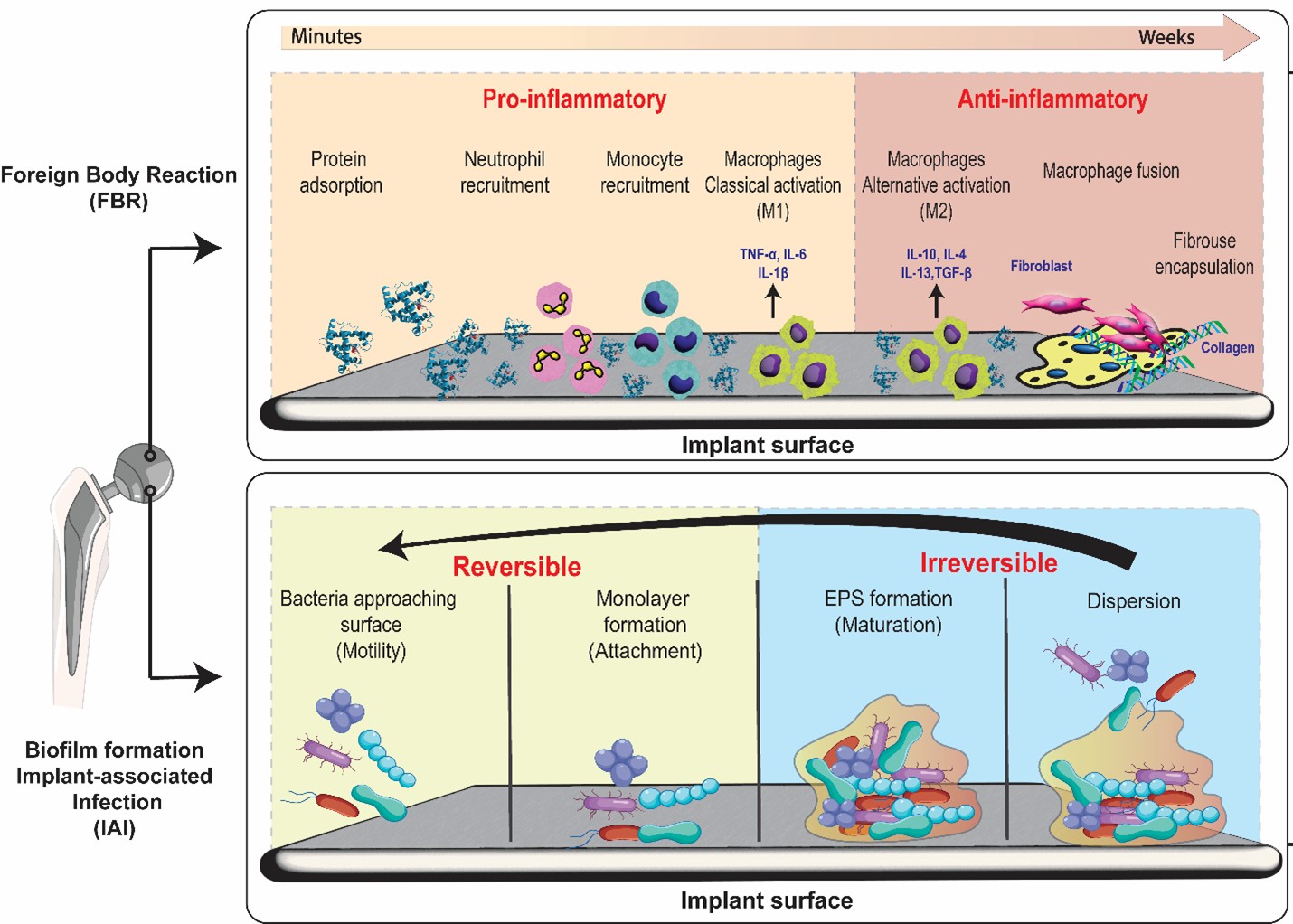
Upon implanting a (bio)material, the host’s immune system is activated, and a series of actions are initiated to recognize and respond to the foreign body. This so-called foreign body reaction (FBR) is ignited by tissue injury around the implant, which is believed to occur in five overlapping stages: 1. adsorption of blood components and formation of an extracellular matrix (ECM); 2. acute inflammation; 3. chronic inflammation; 4. macrophage activation and formation of foreign body giant cells (FBGCs) as a result of fusion; and 5. fibrotic capsule formation due to fibroblast activation.
Macrophages play a crucial role in FBR
Depending on the environmental cues, macrophages can adopt to a spectrum of activation state, including pro-inflammatory M1 and anti-inflammatory M2 states. M1 macrophages play a critical role in initiating and sustaining inflammatory responses by releasing pro-inflammatory cytokines that activate endothelial cells. This leads to the recruitment of additional immune cells to the inflamed tissue and promotes the phagocytosis of pathogens. In contrast, M2 macrophages promote resolution of inflammation by secreting anti-inflammatory mediators, clearing apoptotic cells, stimulating collagen deposition, and helping to preserve tissue integrity.
Impact of biomaterial properties on macrophage polarization and tissue repair
Biomaterial-based therapies are designed to promote tissue regeneration and prevent host inflammatory responses and implant rejection. However, the physical, chemical, and bioactive characteristics of biomaterials, such as surface topography, stiffness, and wettability, play a key role in modulating macrophage polarization. For example, materials featuring specific surface roughness or nano/micro-topographies can influence the activation state and phenotype of macrophages by modulating their spreading area and shape. Softer substrates have been shown to be more effective at suppressing pro-inflammatory macrophage phenotypes than stiffer ones.
Infection further exacerbates the implant microenvironment
The process of FBR may possibly disrupt the immune defense function at the implant site and predisposes the foreign surface to infection and bacterial colonization. Consequently, the implant’s surface turns into a suitable niche for pathogenic bacteria to adhere and establish biofilm. Biofilms are present in almost 65% of acute bacterial infections, and in 80% of chronic infections. High doses of antibiotics for prolonged periods are often prescribed to treat implant infections yet can weaken the host defense system and cause tissue toxicity.
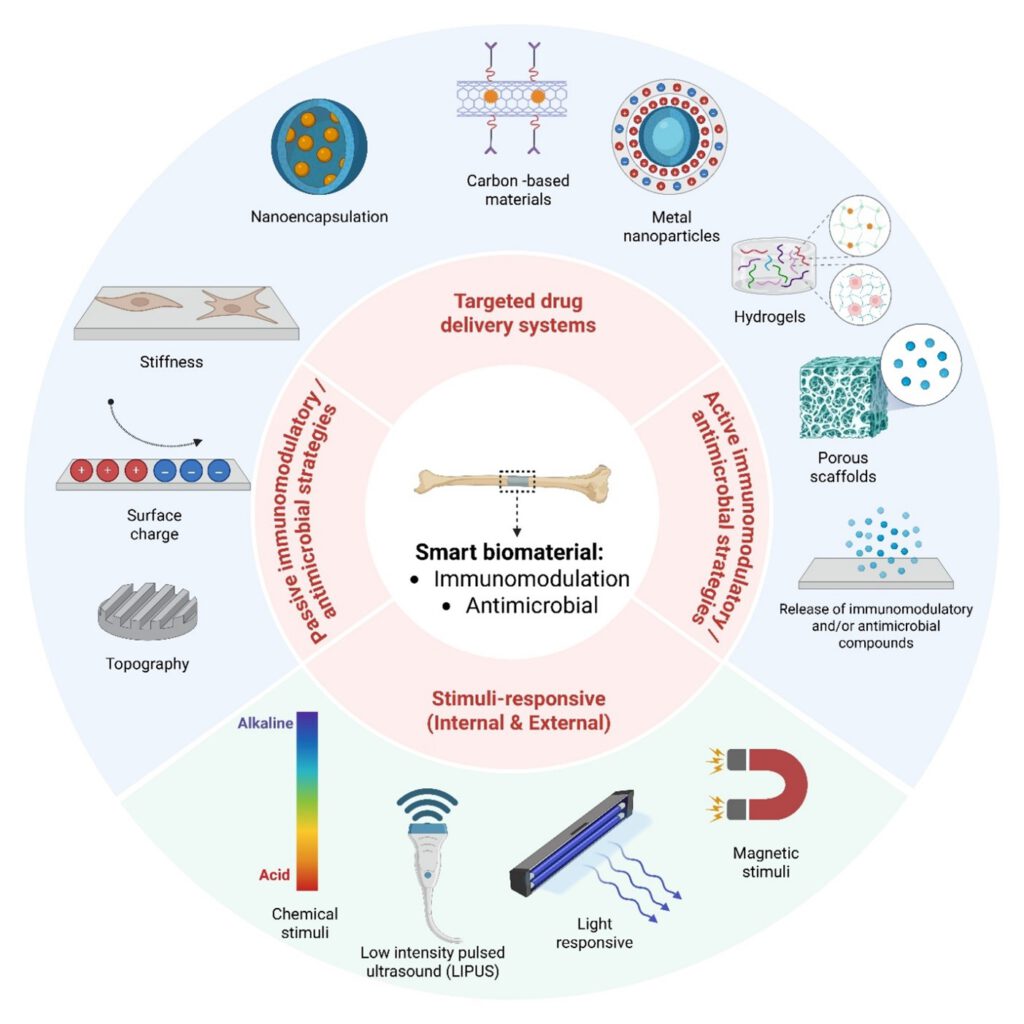
Emerging technologies: Dual-function biomaterials for simultaneous management of FBR and implant infections
More recently, a new class of implantable biomaterials that simultaneously address FBR and infection risk has emerged. These materials usually combine antimicrobial agents with immunomodulatory components to prevent bacterial colonization while enhancing integration of implant to the host tissue. Stimuli-responsive biomaterials are another type of dual-function materials, engineered to respond to internal or external triggers to detect, act and modulate the FBR microenvironment and tackle bacterial infection. In this context, enzymes, pH, light, heat, ultrasound or electric fields have been the major stimuli to promote antimicrobial activity, modulate inflammation and stimulate tissue regeneration.
Despite the development of numerous antifouling, biocompatible materials and bioactive coatings in laboratory settings, their long-term efficiency in multifaceted environment of the human body and translation to clinical practice require rigorous exploration. Nevertheless, novel technologies are already employed to decipher complex microbiota-immune system interactions and, coupled with advances in material science, offer hope for affected patients.
This blog was written by Sajad Mohammadi, one of the PhD candidates working in the SSBB consortium. Sajad is pursuing his PhD trajectory at Erasmus MC University Medical Center Rotterdam and Hylomorph.
“The project STOP SPREAD BAD BUGS has received funding from the European Union’s Horizon Europe research and innovation programme under grant agreement N⁰ 101073263.”
Reference:
[1] S. Mohammadi, L.M. Bomfim, W.W.J. Unger, Revolutionizing care: Recent innovations and the future of treating implant-induced infections and inflammation, Biomaterials Advances 188 (2026) 214988. https://doi.org/10.1016/j.bioadv.2026.214988.