
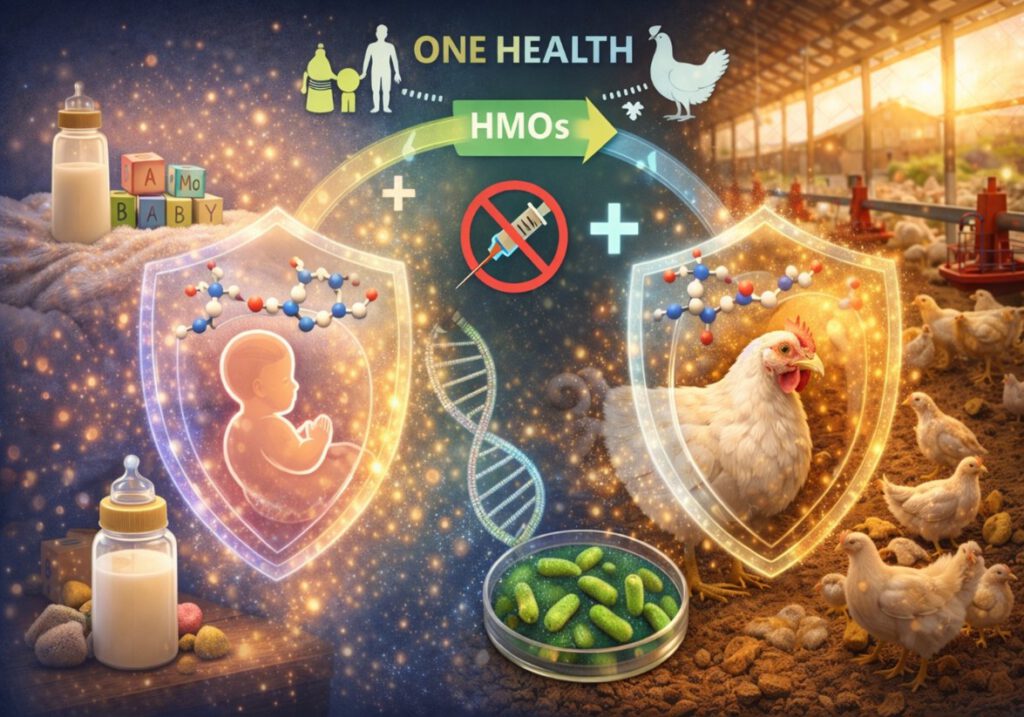
Beyond the Nursery: Why Poultry is the New Frontier for HMOs
Usually, when people hear the words “Human Milk Oligosaccharides” (HMOs), they think of nursery rhymes and sleepy babies. And it makes perfect sense. HMOs are the unsung heroes of the human immune system, acting as a natural shield for newborns when they’re at their most vulnerable.
But here in the Stop Spread Bad Bugs (SSBB) project, we’re trying a bit of a scientific crossover: What if we take those “human” sugars and put them to work in… a chicken coop? Yeah, I know. It sounds like a bit of a curveball. But hear me out.
In the poultry world, E. coli is the ultimate villain. It lives in the dust and the litter of the barns, which means for a chicken, infection is often just one breath away. Once inhaled, these bacteria, specifically Avian Pathogenic E. coli (APEC), hitch a ride into the bloodstream and spread to the organs. It’s a disaster for the birds and a massive headache for farmers. For decades, the “go-to” move was just to use antibiotics. But we’ve all seen how that story ends, and it’s not with a happy ending for global health.
So, why not look at nature’s own toolkit instead?
That’s exactly where my research steps in. I’m bringing high-tech human biology right into the coop to see if we can use HMOs to protect a completely different species. It’s a “One Health” approach that finally breaks those old silos between human and animal medicine. And the best part? It’s not just a cool experiment; it’s a total game-changer for the industry. We’re talking about a roadmap for HMO producers and feed mills to create “green,” bio-based alternatives to traditional drugs, leading to a cleaner, more transparent food chain for all of us.
At the end of the day, “Stopping the Spread” doesn’t always mean inventing a new chemical. Sometimes, the smartest solution is already out there, hidden in plain sight. By repurposing the secrets of the nursery for the farm, we’re proving that a fresh perspective can create a safer future for animals and humans alike.
This blog was written by Maryam Anwer, one of the PhD candidates working in the SSBB consortium. Alessia is pursuing her PhD trajectory at Anitom and the University of Utrecht.
“The project STOP SPREAD BAD BUGS has received funding from the European Union’s Horizon Europe research and innovation programme under grant agreement N⁰ 101073263.”