
How bacteria survive antibiotics: Resistance, Tolerance and Persistence.
Have you ever wondered how sometimes, after a “killer dose” of antibiotics, a small fraction of bacteria just… hang on? And no, it’s not always because they’ve mutated and turned into super resistant bacteria. The truth is more nuanced: bacteria can dodge antibiotics in different ways — by being resistant, tolerant, or persistent. Understanding the difference is key if we want smarter antibiotics.
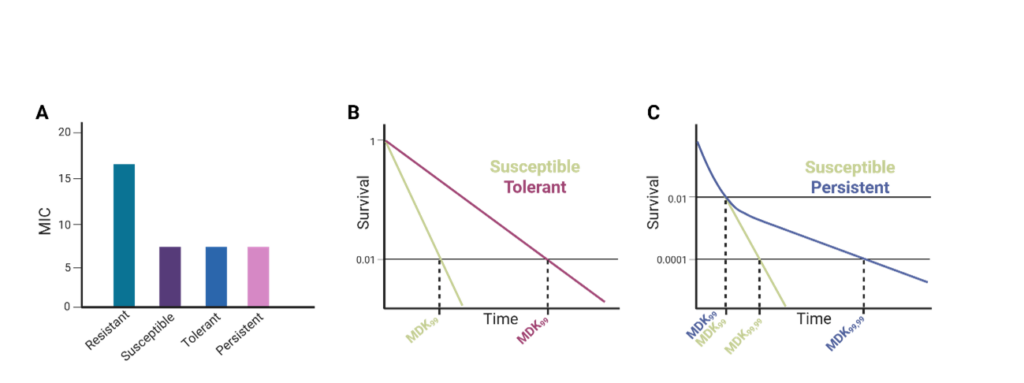
- Resistance: When bacteria are resistant, they’ve acquired (or evolved) a trait — say, a pumping system that ejects the drug, or an enzyme that breaks it down, or a slightly altered target that the antibiotic can’t bind. Because of that, they can grow even in the presence of the drug. The minimal concentration needed to stop them (MIC, minimum inhibitory concentration) goes way up (Figure A). In short: the antibiotic just doesn’t work.
- Tolerance: Tolerant bacteria don’t resist the antibiotic itself. Instead, when exposed to a lethal drug dose, they die more slowly, increasing the minimum duration for killing (MDK)(Figure B). The trick is: the drug doesn’t kill them faster even if you increase its concentration — it just takes more time. So the MIC stays the same (Figure A), but the duration needed to kill
- Persistence: Persistence is a twist on tolerance. A persistent bacterium is one among a subpopulation that survives long antibiotic exposure much better than others in the same population. Meaning it’s a phenotypic heterogeneity phenomenon. Some characteristics that distinguish persistence are:
- The overall MIC of the population is the same as for non-persistent ones (Figure A). Persistence doesn’t mean the population as a whole became resistant.
- In a time-kill assay, you often see a biphasic killing curve: a fast initial drop (most bacteria die, same MDK99 for susceptible and persisters), then a slow tail (the persisters, with higher MDK99 than susceptible) (Figure C).
- If you take survivors (the persisters), regrow them without antibiotics, and treat them again, their progeny behave just like the original population — they haven’t permanently changed (If they had, you might suspect resistance!)
Next time you hear about ‘superbugs,’ remember — not all survivors are resistant. Think of it this way: resistant bacteria wear armor, tolerant bacteria slow time, and persisters play dead until danger passes. If we want to beat them, we’ll need treatments that don’t just block their armor but also counter their patience and persistence. The real challenge, and opportunity, is to out-think their survival strategies and staying one step ahead.
This blog was written by Ana Laura Pereira Lourenço, one of the PhD candidates working in the SSBB consortium. Ana Laura is pursuing her PhD trajectory at Hylomorph and the Institute of Agrifood Research & Technology.
“The project STOP SPREAD BAD BUGS has received funding from the European Union’s Horizon Europe research and innovation programme under grant agreement N⁰ 101073263.”
Reference:
Balaban NQ, Helaine S, Lewis K, Ackermann M, Aldridge B, Andersson DI, et al. Definitions and guidelines for research on antibiotic persistence. Nat Rev Microbiol. 2019 July;17(7):441–8. Access: Definitions and guidelines for research on antibiotic persistence | Nature Reviews Microbiology