
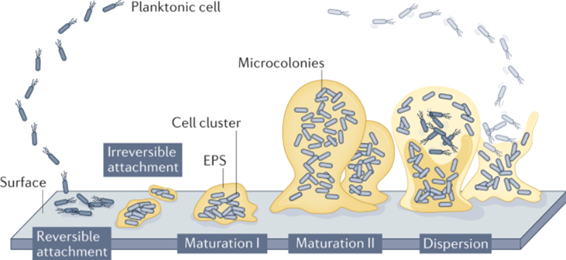
When we think of bacteria, we often imagine free-floating single cells that can be eliminated with antibiotics or disinfectants. In reality, many bacteria prefer to live in communities, called biofilms- slimy, structured layers that adhere to surfaces.
This becomes a serious concern in healthcare due to the spread use of implantable medical devices which provide bacteria with ideal footholds. Once a foreign surface is introduced into the body, it rapidly becomes coated with host proteins in a process known as conditioning film formation. This protein layer creates a perfect landing zone for bacterial adhesion, setting the stage for biofilm development directly on the device surface.
What is a biofilm?
A biofilm is a structured community of bacteria encased in a self-produced protective matrix of proteins, polysaccharides, and DNA. This matrix allows bacteria to stick to surfaces and to each other, creating a resilient ecosystem.
Why do biofilms make bacteria harder to eliminate?
One of the most alarming features of biofilm-associated bacteria is their increased resistance compared to free-floating (planktonic) bacteria. Research shows that bacteria within biofilms can be up to 1,000 times more resistant to antibiotics and disinfectants. Several factors contribute to this:
- Protective barrier: The biofilm matrix acts as a physical shield, slowing or preventing the penetration of antibiotics and immune cells.
- Dormant cells: Within the biofilm, some bacteria enter a slow-growing or dormant state. Since many antibiotics target actively dividing cells, these dormant bacteria escape treatment.
- Gene sharing: Close proximity within biofilms facilitates the exchange of resistance genes, helping bacteria evolve and spread defense mechanisms more effectively.
- Stress Response: Biofilm bacteria can activate survival pathways that make them less vulnerable to environmental stress, including drug exposure.
Clinical Implications
Because of these resistance mechanisms, infections involving biofilms are notoriously difficult to treat. Patients may require prolonged antibiotic therapy, higher drug doses, or even surgical removal of contaminated devices. This is especially critical for patients with implanted devices such as prosthetic joints, pacemakers, or urinary catheters, where biofilm formation can lead to chronic infections and serious complications.
Preventing Biofilm-Associated Infections
Addressing biofilm-related resistance requires a multifaceted approach:
- Device design improvements to reduce bacterial attachment.
- Antimicrobial coatings on medical devices.
- Alternatives to antibiotic prophylaxis.
- Novel therapies targeting the biofilm matrix or using enzymes, phages, or nanoparticles to disrupt bacterial communities.
This blog was written by Alessia Maranesi, one of the PhD candidates working in the SSBB consortium. Alessia is pursuing her PhD trajectory at Hylomorph and the Institute of Agrifood Research & Technology.
“The project STOP SPREAD BAD BUGS has received funding from the European Union’s Horizon Europe research and innovation programme under grant agreement N⁰ 101073263.”
References
[1] Bhagwat, G., O’Connor, W., Grainge, I., & Palanisami, T. (2021). Understanding the fundamental basis for biofilm formation on plastic surfaces: Role of conditioning films. Frontiers in Microbiology, 12, 682849. https://doi.org/10.3389/fmicb.2021.682849
[2] Busscher, H. J., van der Mei, H. C., Subbiahdoss, G., Jutte, P. C., van den Dungen, J. J., Zaat, S. A., Schultz, M. J., & Grainger, D. W. (2020). Controlling experimental parameters to improve characterization of biofouling on biomaterials. ACS Applied Materials & Interfaces, 12(50), 55683–55694. https://doi.org/10.1021/acsami.0c15049
[3] Dutta Sinha, S., Chatterjee, S., Maity, P. K., Tarafdar, S., & Moulik, S. P. (2014). Studies of protein adsorption on implant materials in relation to biofilm formation I. Activity of Pseudomonas aeruginosa on polypropylene and high‐density polyethylene in presence of serum albumin. arXiv. https://arxiv.org/abs/1411.5108
[4] Khatoon, Z., McTiernan, C. D., Suuronen, E. J., Mah, T.-F., & Alarcon, E. I. (2018). Bacterial biofilm formation on implantable devices and approaches to its treatment. Heliyon, 4(12), e01067. https://doi.org/10.1016/j.heliyon.2018.e01067
[5] Katsikogianni, M., & Missirlis, Y. F. (2004). Concise review of mechanisms of bacterial adhesion to biomaterials. European Cells & Materials, 8, 37–57. https://doi.org/10.22203/ecm.v008a05
[6] Le, H., et al. (2025). Pre-adsorption of serum albumin on biomaterial surfaces: Effect on device–bacteria interactions. Bioactive Materials, 32, 155–166. https://doi.org/10.1016/j.bioactmat.2025.06.015