
Innovative approaches against bacterial infection are a vital necessity. Nowadays, most of the antibiotics on the market are targeting one single bacterial process to take them down, leading to a rapidly adaptation and development mechanism to counteract the medication. Dual-action molecules which exert two distinct biological activities represent a powerful alternative to conventional monotherapy. By simultaneously targeting multiple bacterial pathways, a single chemical entity can not only enhance bactericidal efficacy but also reduce the likelihood of bacteria developing resistance through multiple defence mechanisms at once.
The design strategy of such molecules usually involves the hybridization of two pharmacophores with known biological properties. These can include enhancing antibiotic uptake, improving retention inside bacterial cells, incorporating membrane-disruptive carriers, enabling targeted delivery systems, or even providing anti-inflammatory effects.
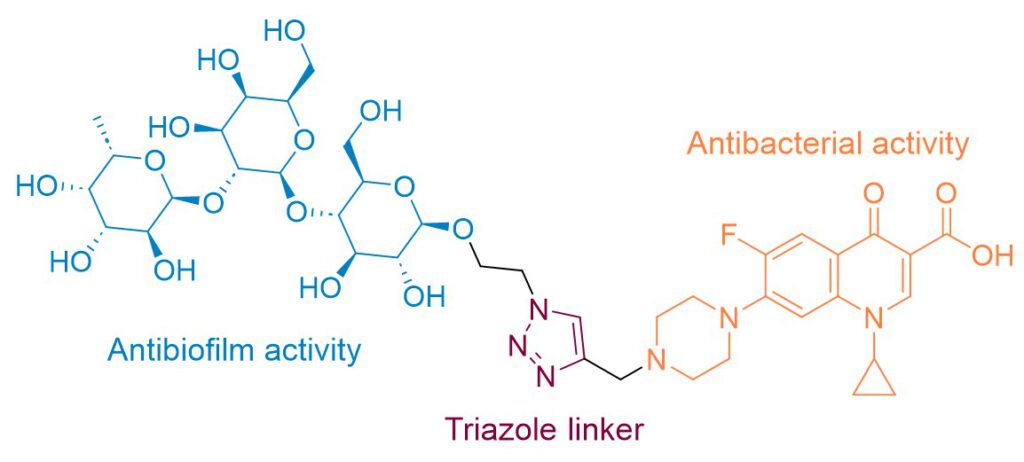
Within the “Stop Spread Bad Bugs” Marie Curie consortium, we have chosen to combine antibacterial activity with an antibiofilm property (Figure 1). The biofilm is a cluster of cells produced by bacteria that covers and shields them against any threat that might stopped the infection, like antibiotics. An antibiofilm compound do not necessary kill bacteria but can prevents the formation of this biofilm and disrupts the infection process.
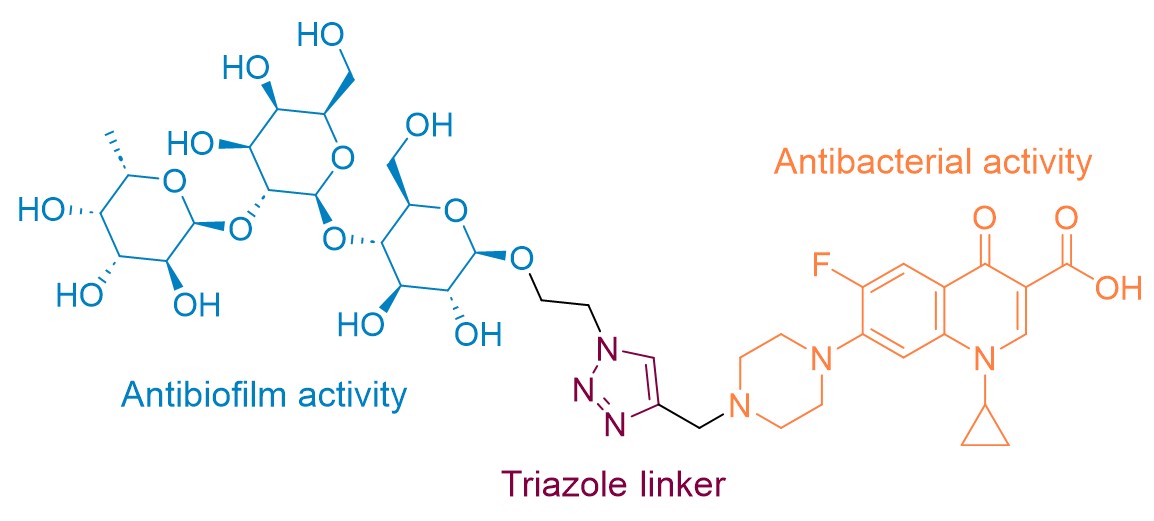
Figure 1. Model structure of target compounds. Bleu: antibiofilm moiety (human milk oligosaccharide “HMO”), purple: triazole linker, orange: bactericidal moiety (ciprofloxacin).
The left side of the molecule (in blue) is the antibiofilm part, made from a human milk oligosaccharide called HMO. These sugars, naturally found in breast milk, help protect babies by preventing bacterial infections. The middle section (in purple) is a triazole linker, made using a clever “click chemistry” reaction that earned a Nobel Prize in 2022. The right side (in orange) is the antibiotic, ciprofloxacin, which interferes with the bacterial DNA leading to irreversible DNA damage and ultimately bacterial cell death.
Upon the synthesis of a series of molecules with various combination of HMO and antibiotics, the antibacterial testing revealed that some of them are active against bacteria. The next step is to determine whether this activity results from a synergy between the two modes of action (antibiofilm and anti-bactericidal).
This blog was written by Liza Nguyen, one of the PhD candidates working in the SSBB consortium. Liza is pursuing her PhD trajectory at the University of Stavanger and SetLance.
“The project STOP SPREAD BAD BUGS has received funding from the European Union’s Horizon Europe research and innovation programme under grant agreement N⁰ 101073263.”